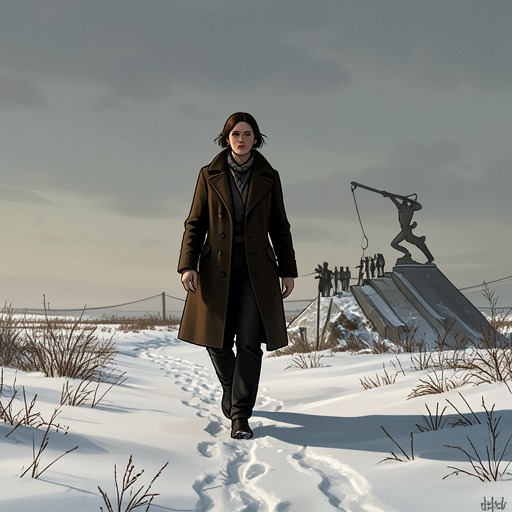
Ghost shirt
The Master Butchers Singing ClubThe Ghost shirt is a scrap of yellowed muslin and fringe that Step-and-a-Half preserves from the Wounded Knee massacre. Given to her by a Lakota woman, the cloth becomes both a tangible remainder of a violent past and a source of solace: Step-and-a-Half understands it as a way for the living to draw comfort from the dead through song.
Origin and Survival
During the massacre, a woman fleeing with Minnie gives Step-and-a-Half a piece of a shirt to wear beneath her coat. Step-and-a-Half survives the ensuing attack and, much later, still keeps a scrap of that garment. The evidence identifies it not as an intact shirt but as a fragment: yellowed muslin with tattered fringe, preserved across the long interval between the event and her old age.
Its survival makes the cloth a personal trace of the people and circumstances that would otherwise recede into history. Step-and-a-Half’s association with it reaches back to a moment when Minnie’s family and the woman who sheltered and helped her were caught in the violence. The garment does not undo that loss; its importance lies in carrying a connection forward.
Appearance and Place in the Quilt
In old age, Step-and-a-Half encounters the fragment as one of the pieces sewn into a familiar quilt. She touches its faded painting of a crow, with bright eyes and an open beak, and presses her cheek against the image of a horned white moon. The small details distinguish the scrap from an abstract emblem: it is worn cloth, marked by a specific design, incorporated into an everyday object that offers physical comfort.
The quilt brings the shirt into the texture of Step-and-a-Half’s later life. Rather than being displayed as a public relic, the fragment remains close to her, held within a blanket that is familiar against her face. Its presence in the quilt joins an object associated with catastrophe to the ordinary intimacy of warmth, touch, and rest.
Protection, Memory, and Song
Step-and-a-Half knows that some people say Ghost Dance shirts were believed to protect their wearers from bullets. She rejects the implication that the dancers were foolish or deluded. In her understanding, they knew something that is sometimes forgotten: the dead remain close, separated from the living by only a song. The cloth’s significance is therefore not presented as proof of physical protection. It expresses a spiritual understanding of memory and continuing connection.
That connection is carried by remembered voices. Step-and-a-Half recalls soldiers singing before the violence, as well as a mother’s lullaby heard across a tent. In the later scene, the quilt and the shirt are accompanied by songs imagined or heard in the world around Argus, from lullabies and hymns to ballads and anthems. The shirt gives material form to the idea that songs can travel between the living and the dead, preserving nearness without erasing what happened.
Narrative Significance
The fragment links Step-and-a-Half’s private memory to the historical violence that shaped her life. Its passage from the woman who gave it to her, to the child who survived, and into the quilt she keeps in old age compresses a long history into a single piece of cloth. The object’s worn condition records duration, while its continued presence refuses the finality of forgetting.
The Ghost shirt also complicates the meaning of protection. The story does not treat the garment as a shield that prevents death; instead, Step-and-a-Half’s belief locates its protection in remembrance, song, and the comfort of those who remain connected to the dead. As a keepsake and a fragment of clothing, it makes that belief intimate and concrete.